Showing posts with label India. Show all posts

Saturday, April 24, 2021

Reliving History: Nehru's 1958 Visit to Thiruvananthapuram in Stunning 4K Color Restoration with Deep Learning AI

This is my first attempt of video restoration with deep learning AI models.

Color restoration using deep learning AI is an exciting and innovative technology that can bring old black and white photographs and videos to life. By using artificial intelligence algorithms, it is possible to add color to historic images and videos with incredible accuracy and detail, providing a new and captivating way to relive the past.

One fascinating example of the power of deep learning AI color restoration is the restoration of old footage of Jawaharlal Nehru's visit to Thiruvananthapuram in 1958. The original footage was in black and white, but with the help of deep learning AI, it has been colorized to stunning effect, providing a vivid and immersive experience of this historic event.

The process of color restoration using deep learning AI involves training a neural network on a vast dataset of images and videos to recognize and replicate the colors that would have been present in the original scene. This involves teaching the network to recognize patterns and textures, as well as to understand the relationships between different colors in the image.

Once the neural network has been trained, it can be used to colorize new images and videos with remarkable accuracy. The technology can be used to add color to everything from historic photographs and film footage to more recent digital media, providing a new and engaging way to experience the past.

Color restoration using deep learning AI is not without its challenges, however. The technology requires access to high-quality source material, as well as careful calibration to ensure that the colors are accurately replicated. It also requires significant computational resources to process large datasets and produce high-quality results.

Despite these challenges, the potential benefits of color restoration using deep learning AI are enormous. By bringing historic images and videos to life in full color, this technology offers a new and immersive way to experience the past, enabling us to connect with history in a more immediate and engaging way than ever before.

Processing done

  • Denoising/Deinterlacing/Restoration with fewer motion artifacts and video detail recovery using AI Enhanced models.
  • Colorization using deep learning AI models.
  • 4K 60fps conversion.

Input: 640×360/672×504 @ 25fps in B/W

Output: 3140×2160 @ 60fps in Color

You can view original source videos from here:

And

https://www.britishpathe.com/video/VLVACT3MUL8FNYRS3E8VQLKBB3S89-INDIA-NEHRU-VISITS-KERALA/query/VISIT

Behind the video,
For the first time since the Communist assumption of power in the state of Kerala, India, the Prime Minister of India, Mr. Jawaharlal Nehru has paid an official state visit.

His first point of call was at Trivandrum, the capital where he was met by the Governor of the State, Mr Ramakrishna Rao (wearing the cap) and the Communist Chief Minister Mr. E.M.S. Nambudripad. The Governor garlanded Mr. Nehru as he stepped down from the plane, and shook hands. Then flowers and Arti (candle lights) were offered in Kerala traditional, fashion, and 68 pigeons were released to follow the one Mr. Nehru released, the whole to symbolize Mr. Nehru’s 69 years of peaceful life.

On the way into the town shouting crowds lined the route ‘Nehru Zindabad’ they called – Long Live Nehru – Later Mr. Nehru inaugurated the Mahatma Gandhi College in Trivandrum.

Here is the final rendering,

Monday, October 5, 2015

Blood Moon from Sree Padmanabha Swamy Temple, Thiruvananthapuram

Blood Moon is sometimes used to describe a Total Lunar Eclipse. When the Earth casts its shadow on a Full Moon and eclipses it, the Moon may get a red glow.

Below is a composite photograph by me, which shows how a Blood Moon will look like when viewed from Kerala, Southern State of INDIA.

The image is taken in front of The World's Richest Temple Sree Padmanabha Swamy Temeple, Thiruvananthapuram Kerala. 

In recent years, the term Blood Moon has been frequently used to refer to total lunar eclipses. Some sources suggest that the term stems from the Bible. Christian pastors Mark Blitz and John Hagee claim that the eclipses of the 2014-2015 lunar tetrad fulfill a Biblical prophecy of forthcoming difficult and trying times.

Astronomers do not use Blood Moon as a scientific term. However, it is possible that the term came to describe total lunar eclipses because of the reddish color the eclipsed Moon takes on during totality. This happens because of Rayleigh scattering, the same mechanism that causes colorful sunrises and sunsets.


The full Moon of September 27/28 is a Supermoon – the Moon will be closest to the Earth. or at its perigee, as it turns into a full Moon. A rising Super Full Moon can look larger and brighter to spectators on Earth.

Total eclipses of Super Full Moons are rare. According to NASA, they have only occurred 5 times in the 1900s – in 1910, 1928, 1946, 1964 and 1982. After the September 27/ 28, 2015 Total Lunar Eclipse, a Supermoon eclipse will not happen again for another 18 years, until October 8, 2033.


This is how Blood Moon from Trivandrum will look like.


Monday, February 2, 2015

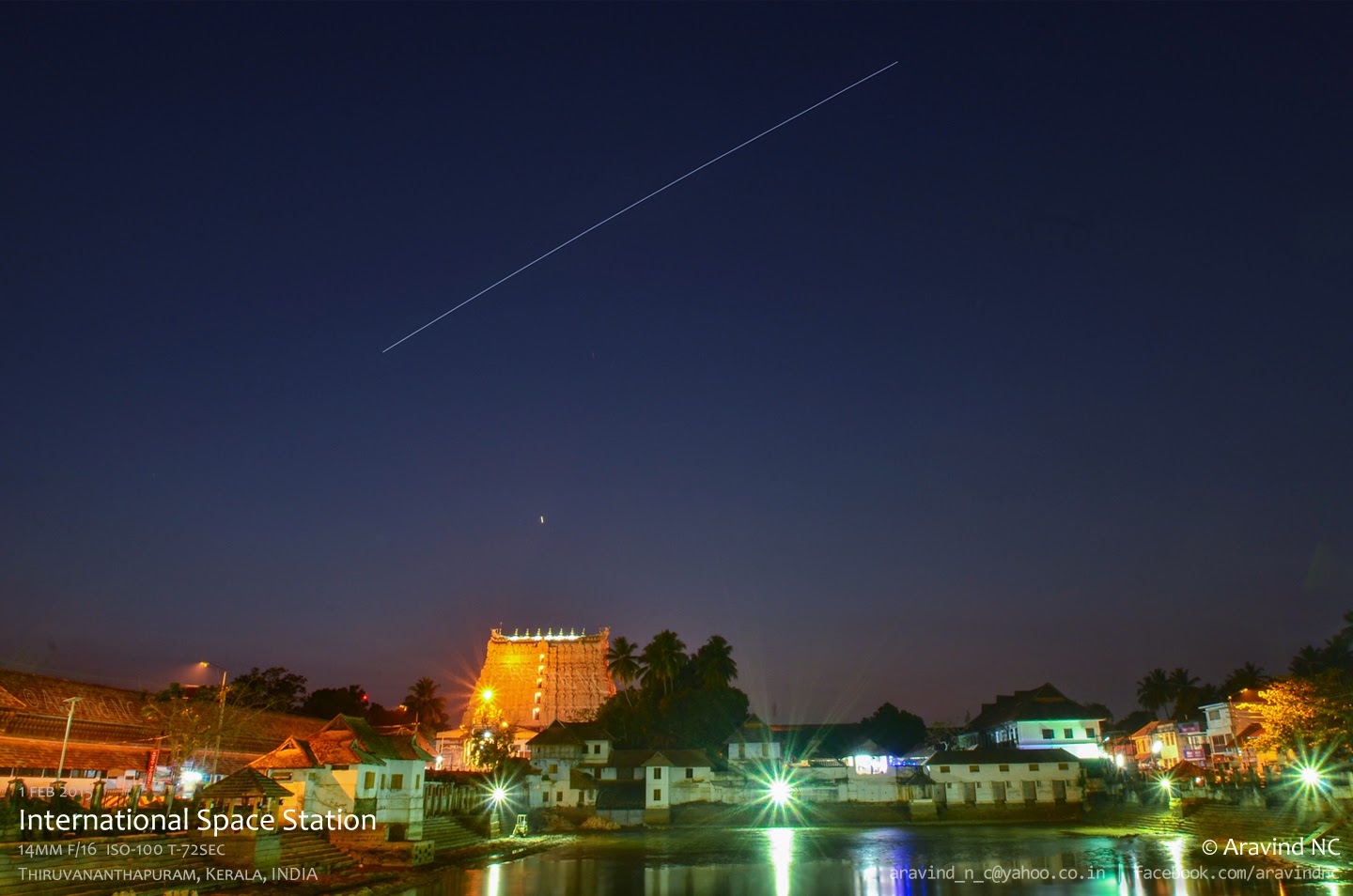
International Space Station over Sree Padmanabha Swami Temple Kerala INDIA

Above image is the passage of International Space Station over Sree Padmanabha Swami Temple in Kerala, India. You can see the brightest planet, Venus just above the temple.

Sree Padmanabhaswamy temple is a Hindu temple dedicated to Lord Vishnu.The temple is one of the 108 Divya Desams (Holy abodes of Vishnu).It is believed that Lord Vishnu’s idol was found in this place.In this temple Lord Vishnu can be seen in a state of sleep on Sheshnaag.The idol of this temple is made up of 12008 salagramams that compose the reclining Lord.The temple has blend of Dravidian and Kerala architecture styles.It has become as one of the richest temples in India with more than 1 lakh crore rupees of worth treasures.

View full version : https://www.flickr.com/photos/aravind_n_c/16242431257/

Interpreting the Data

The text listing is in a column format, a sample of which is shown below:
 

Satellite Local
(date/time)
Duration
(min)
Max Elevation
(deg)
Approach
(deg-dir)
Departure
(deg-dir)
ISS Sun Feb 1, 7:06 PM 4 42 37 above W 10 above NNE

Image of a graphic showing how to locate a satellite during a viewing opportunity.
The left column is the satellite. The next column is the local date and the local time. The third column gives the duration, or the length of time in minutes the spacecraft is expected to be visible, assuming a clear sky. The fourth column gives the maximum elevation the vehicle will achieve above the horizon (90 degrees is directly overhead). The fifth column tells the direction and elevation at which the spacecraft will become visible initially. The sixth column gives the direction and elevation at which the spacecraft will disappear from view.
This sighting opportunity is illustrated in the figure below:

Image above: Satellite sighting graphic shows how to locate a satellite during a viewing opportunity. 

Credit: Richard Czentorycki (RSIS)/NASA.

Viewing Tips

For best results, observers should look in the direction and at the elevation shown in the appearing column at the time listed. Because of the speed of an orbiting vehicle, telescopes are not practical. However, a good pair of field binoculars may reveal some detail of the structural shape of the spacecraft.

Popular Posts