Showing posts with label My Stories. Show all posts

Monday, November 21, 2022

Internet Radio with Malayalam Channels


In today's digital age, creating an internet radio has become easier than ever before. With just a few simple steps, you can set up your own radio station and broadcast your favorite tunes to the world. In this article, we'll show you how to create an internet radio using HTML, with the help of external radio stations.


Getting Started

To get started with your internet radio, you will need basic knowledge of HTML, CSS, and JavaScript. You will also need a web server to host your radio station. You can either use a free web hosting service or a paid one, depending on your budget.

Next, you need to find external radio stations that you want to broadcast on your radio. There are several online directories where you can find radio stations based on genre or location. You can also search for the radio station's URL directly.

Adding Your Own Audio Content

In addition to broadcasting external radio stations, you can also add your own audio content to your internet radio. To do this, you will need to convert your audio files to a compatible format, such as MP3 or AAC. You can then host these files on your web server and add them to your HTML page using the same <audio> tag as before.

Promoting Your Internet Radio

Once your internet radio is up and running, it's time to promote it to the world. You can start by sharing your radio station on social media platforms like Facebook, Twitter, and Instagram. You can also submit your radio station to online radio directories to reach a wider audience.

You can check my radio player at https://fm.aravindnc.com/


Thursday, January 16, 2020

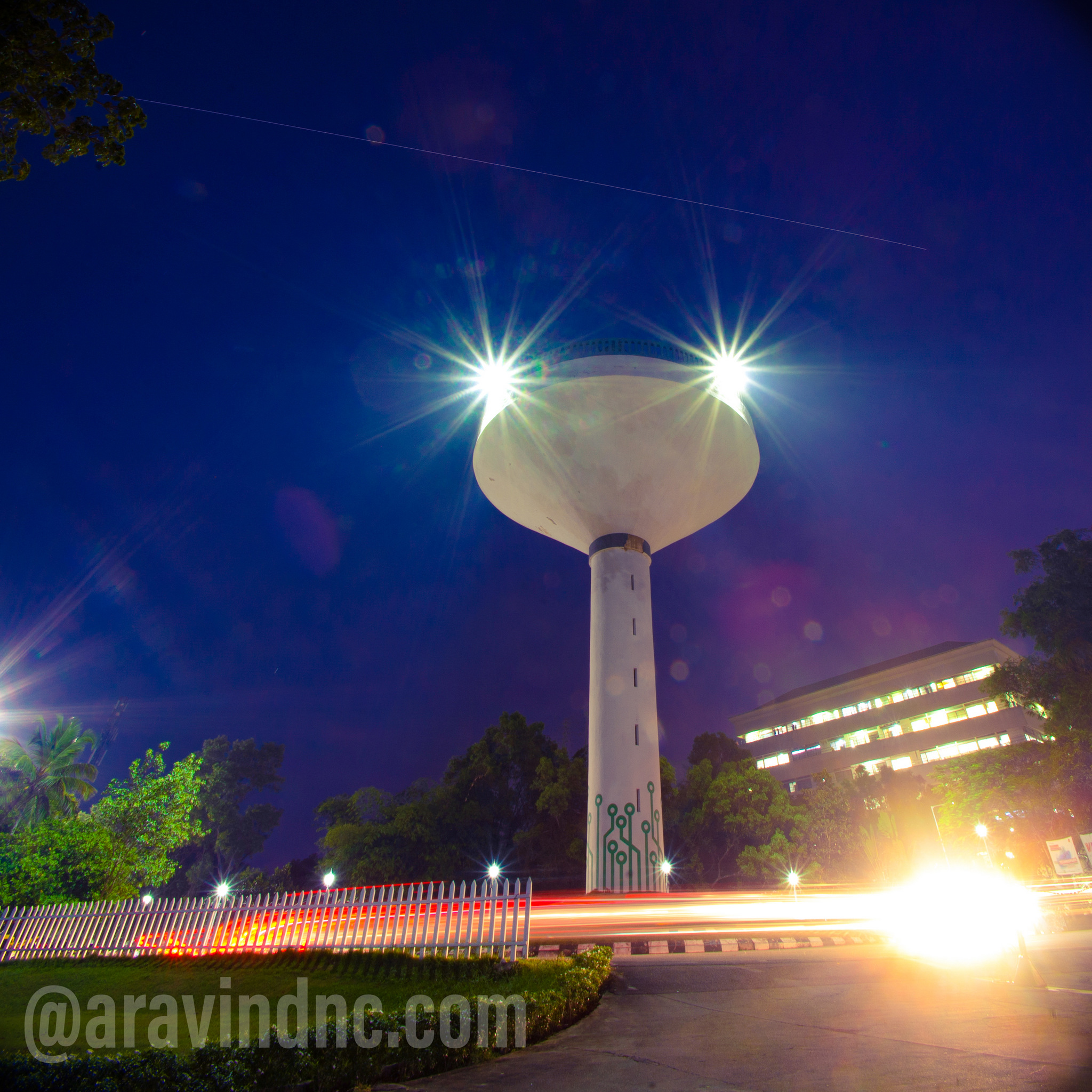
Transit of International Space Station over Technopark, Thiruvananthapuram

Yesterday I got a chance to capture the transit of International Space Station. The iridium flare was too faint due to the light pollution in the foreground.

In the foreground, you can see the iconic water tank of Technopark, Thiruvananthapuram – the largest IT hub in INDIA.

Here are more specs regarding the transit,

DateVisibleMax Height*AppearsDisappears
Wed Jan 15, 6:52 PM6 min62°10° above SSW11° above NE

Tuesday, January 7, 2020

Comet Lovejoy aka C/2014 Q2 captured from Thiruvananthapuram Kerala INDIA

This is my second experience in capturing a comet. This time its Lovejoy. The photo was taken from Thiruvananthapuram (Google Map). The sky was too polluted due to the nearby airport lights, so direct single capture was impossible. And I’ve managed it by taking multiple shots of dark, light, flats and biased pics using a prime lens(50mm) with f/2.8 and processed using Registax.

Here is the output,


Date: INDIA on 24th Jan 2015 7:30 PM. The image is taken without telescope, using DSLR with 50mm lens.

C/2014 Q2 (Lovejoy) is a long-period comet discovered on 17 August 2014 by Terry Lovejoy using a 0.2-meter (8 in) Schmidt–Cassegrain telescope. It was discovered at apparent magnitude 15 in the southern constellation of Puppis. It is the fifth comet discovered by Terry Lovejoy.

By December 2014, the comet had brightened to roughly magnitude 7.4, making it a small telescope and binoculars target. By mid-December, the comet was visible to the naked eye for experienced observers with dark skies and keen eyesight. On 28−29 December 2014, the comet passed 1/3° from globular cluster Messier 79. In January 2015, it brightened to roughly magnitude 4−5, and became one of the brightest comets located high in a dark sky in years. On 7 January 2015, the comet passed 0.469 AU (70,200,000 km; 43,600,000 mi) from Earth. It crossed the celestial equator on 9 January 2015 becoming better seen from the northern hemisphere. The comet will come to perihelion (closest approach to the Sun) on 30 January 2015 at a distance of 1.29 AU (193,000,000 km; 120,000,000 mi) from the Sun.

Before entering the planetary region (epoch 1950), C/2014 Q2 had an orbital period of about 11000 years. After leaving the planetary region (epoch 2050), it will have an orbital period of about 8000 years.

Discovered byTerry Lovejoy
0.2-m Schmidt (Q80)
Discovery date17 August 2014
Orbital characteristics
Epoch18 January 2015
Perihelion1.29077 AU (q)
Eccentricity0.99811
Orbital period~11000 years inbound (Barycentric solution for epoch 1950)
~8000 years outbound
(Barycentric solution for epoch 2050)
Inclination80.301°
Last perihelion30 January 2015


You can get in touch with me regarding more details of the photograph.

Tuesday, December 31, 2019

Annular Solar Eclipse From Thiruvananthapuram

26th Dec was a luck day For Keralites to capture the Annular Solar Eclipse.

So what is an annular solar eclipse?

An annular solar eclipse happens when the Moon covers the Sun’s center, leaving the Sun’s visible outer edges to form a “ring of fire” or annulus around the Moon. The characteristic “ring of fire”. The ring of fire marks the maximum stage of an annular solar eclipse. (Ref)


So I too got a chance to capture the rare moment, even though our location is only having partial eclipse.

and here is my pic…


Date: 26th Dec 2019

Time: 8:00 AM to 11:15 AM
Location: Thiruvananthapuram, Kerala, India (8.5241° N, 76.9366° E)
Gear: Nikon D610 + 300MM + 1.4 TC with DIY Filter, Smart Camera Assistant, Tripod

More Pics:


And the next Annular Eclipse through Kerala will be on 2031.

Rare planet alignment Mars-Venus-Saturn-Jupiter from Thiruvananthapuram Kerala INDIA

For the first time in more than a decade, ‪#‎Mercury‬, ‪#‎Mars‬, ‪#‎Venus‬, ‪#‎Saturn‬ and ‪#‎Jupiter‬ — the five ‪#‎planets‬ bright enough to be seen with an unaided eye — was visible at once in the sky.

Missing mercury in the image because the sky was super cloudy and mercury was too faint. The image looks too wide as Venus and Jupiter were at both ends of the field.

Mercury will appear lowest to the horizon, and its faint light will be hardest to spot in the southeastern sky (in the Northern Hemisphere). Then, from left to right (from southeast to southwest), you’ll be able to see Venus, Saturn, Mars, and Jupiter, in a line that roughly traces the path the sun will take through the day.


The image is taken from the top of Thejaswini Building, Technopark, Thiruvananthapuram, Kerala, INDIA at 5:40AM on 20th Jan 2016.

Monday, October 5, 2015

Blood Moon from Sree Padmanabha Swamy Temple, Thiruvananthapuram

Blood Moon is sometimes used to describe a Total Lunar Eclipse. When the Earth casts its shadow on a Full Moon and eclipses it, the Moon may get a red glow.

Below is a composite photograph by me, which shows how a Blood Moon will look like when viewed from Kerala, Southern State of INDIA.

The image is taken in front of The World's Richest Temple Sree Padmanabha Swamy Temeple, Thiruvananthapuram Kerala. 

In recent years, the term Blood Moon has been frequently used to refer to total lunar eclipses. Some sources suggest that the term stems from the Bible. Christian pastors Mark Blitz and John Hagee claim that the eclipses of the 2014-2015 lunar tetrad fulfill a Biblical prophecy of forthcoming difficult and trying times.

Astronomers do not use Blood Moon as a scientific term. However, it is possible that the term came to describe total lunar eclipses because of the reddish color the eclipsed Moon takes on during totality. This happens because of Rayleigh scattering, the same mechanism that causes colorful sunrises and sunsets.


The full Moon of September 27/28 is a Supermoon – the Moon will be closest to the Earth. or at its perigee, as it turns into a full Moon. A rising Super Full Moon can look larger and brighter to spectators on Earth.

Total eclipses of Super Full Moons are rare. According to NASA, they have only occurred 5 times in the 1900s – in 1910, 1928, 1946, 1964 and 1982. After the September 27/ 28, 2015 Total Lunar Eclipse, a Supermoon eclipse will not happen again for another 18 years, until October 8, 2033.


This is how Blood Moon from Trivandrum will look like.


Popular Posts